How to Choose the Right Air Purifier
With hundreds of models on the market, picking the right air purifier is genuinely confusing. This guide cuts through the noise — covering every spec that actually matters so you can buy with confidence.
8 Factors That Actually Matter
Ignore the marketing buzzwords. These are the specs that determine whether an air purifier will actually work for your home.
CADR Rating
Clean Air Delivery Rate (CADR) measures how quickly a purifier cleans a room. Higher is better. As a rule of thumb, your CADR should be at least ⅔ of your room's square footage. A 300 sq ft bedroom needs a CADR of at least 200 CFM.
Look for CADR certified by AHAM — it's independently verified.
Room Coverage
Every purifier lists a maximum coverage area, but real-world performance depends on ceiling height and layout. For open-plan spaces or high ceilings (over 9 ft), choose a unit rated 20–30% larger than your actual square footage.
For whole-home coverage, consider multiple units rather than one oversized model.
Filter Technology
True HEPA filters capture 99.97% of particles 0.3 microns and larger — the gold standard for allergens, dust, and smoke. Activated carbon layers handle odors and VOCs. Avoid "HEPA-type" or "HEPA-style" filters — they're not the same thing.
PECO and HEPASilent technologies go further, but cost more per filter replacement.
Noise Level
Noise is measured in decibels (dB). Below 30 dB is near-silent — suitable for bedrooms. 40–50 dB is comparable to a quiet office. Above 55 dB on high is noticeable. Most purifiers run quieter on lower fan speeds, so size up if you plan to run it on low.
Check the noise rating on the lowest fan speed, not just the maximum.
Running Costs
The sticker price is just the start. Factor in filter replacement costs (typically $40–$100 every 6–12 months) and electricity. A 50W purifier running 24/7 adds roughly $5–$7/month to your electricity bill. Some brands lock you into proprietary filters — check before you buy.
Calculate the total 3-year cost of ownership, not just the purchase price.
Energy Efficiency
Look for Energy Star certification — it means the unit meets EPA efficiency standards. Most modern purifiers use 30–60W on high, comparable to a light bulb. Auto mode and air quality sensors help reduce energy use by only running the fan when needed.
Energy Star certified models use up to 40% less energy than non-certified equivalents.
Smart Features
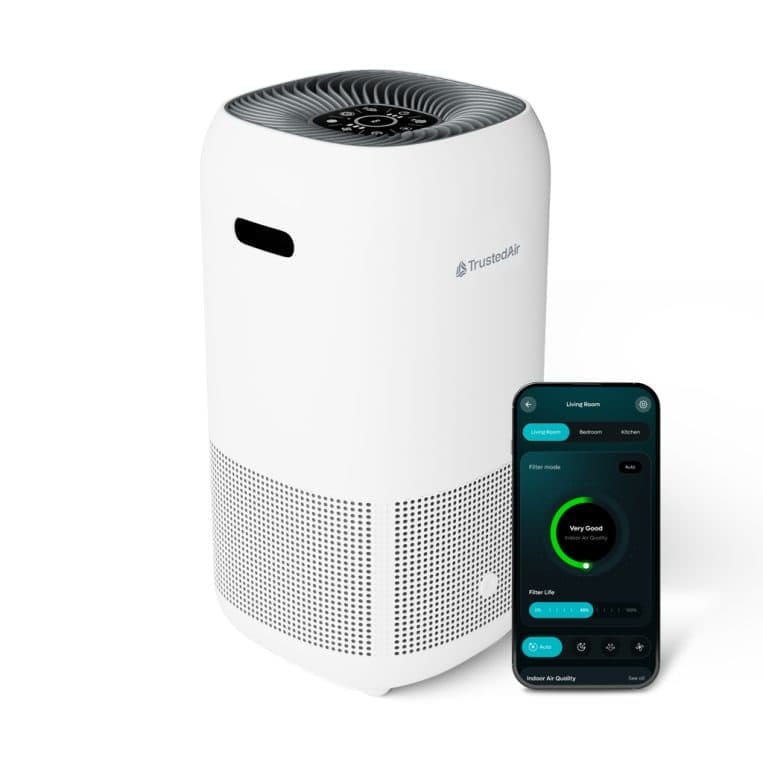
Wi-Fi connectivity lets you control the purifier from your phone, set schedules, and monitor air quality remotely. Built-in air quality sensors automatically adjust fan speed. These features add $50–$150 to the price but are genuinely useful for set-and-forget operation.
Smart features matter most if you travel or want automation — skip them if you prefer simplicity.
What to Avoid
Steer clear of ozone-generating ionizers — the EPA warns they can irritate lungs. UV-C lights are often marketed as germ-killers but have limited real-world effectiveness in consumer purifiers. "HEPA-like" or "HEPA-style" filters don't meet the true HEPA standard.
If a purifier produces a noticeable smell, it's likely generating ozone.
Filter Types Explained
The filter is the heart of any air purifier. Here's how the main technologies compare.
| Filter Type | Filter Cost | Verdict |
|---|---|---|
| True HEPARecommended | $40–$80 / 6–12 months | Best overall |
| Activated Carbon | Usually bundled with HEPA | Essential add-on |
| PECO | $100+ / 6 months | Premium option |
| HEPASilent | $50–$70 / 6 months | Great for large spaces |
| HEPA-type / HEPA-style | $15–$40 | Avoid if possible |
Room Size Guide
Match your room size to the right CADR range — and see which of our tested models fits each scenario.
| Room Type | Size | Min. CADR | Our Pick |
|---|---|---|---|
| Small Bedroom | 100–200 sq ft | 65–130 CFM | Alen BreatheSmart 45i |
| Master Bedroom | 200–400 sq ft | 130–265 CFM | PuroAir 400 |
| Living Room | 400–800 sq ft | 265–530 CFM | TrustedAir TrueFlow |
| Open-Plan Space | 800–1,500 sq ft | 530–1,000 CFM | TrustedAir TrueFlow |
| Whole Home | 1,500+ sq ft | Multiple units | TrustedAir TrueFlow ×2 |
High ceilings or open plans? Add 25% to your minimum CADR requirement. A 10 ft ceiling in a 400 sq ft room has the same air volume as a 500 sq ft room with standard 8 ft ceilings.
Ready to Pick? See Our Top Recommendations
We've tested all five of these against the criteria above. Here's the short list.